
Created by Drizzza

Conjure whole custom Rust worlds in minutes export straight to RustEdit…like it's magic

How it works

Conjure

Conjure Rust-tuned islands.

Roll procedural island seeds in eight island styles and shape them with simple sliders, every noise profile built around Rust's own terrain generation. Save favorites as shareable .hmseed files to reuse across projects.

Plan & Shape

Combine islands into one map.

Place, rotate and scale island seeds into a single landmass, anything from tight archipelagos to full continents. Sculpt by hand with nine terrain brushes, stamps and mirroring, draw or import your own island outline, or cut open channels clean across the map.

Generate the world

Generate the whole Rust world.

One click works out what every part of your terrain is, the way Rust does: the five biomes, Rust's topology layers, a biome-tinted ground coat, forests, lakes as real water bodies, and Rust's own cliff and rock models on the steep ground. Paint over any of it by hand where you want to overrule it.

Save & Export

Export straight to RustEdit.

Send out a ready-to-open Rust .map carrying your terrain, ground textures, biomes, topology, lakes, lava and cliffs together, or export .raw, .png and .xml. Pick your map size in the export panel, or batch every saved project out at once.

Multi-Island Gen

Full Custom Map Generation in One Click

Turn on multi-island randomize and every Conjure rolls a whole map, not just one island: continents, archipelagos, straits, rings, mainlands, volcanic, mountainous and Galapagos, each with real bays, peninsulas and offshore islands. Pick which styles to roll and cap how busy the map gets.
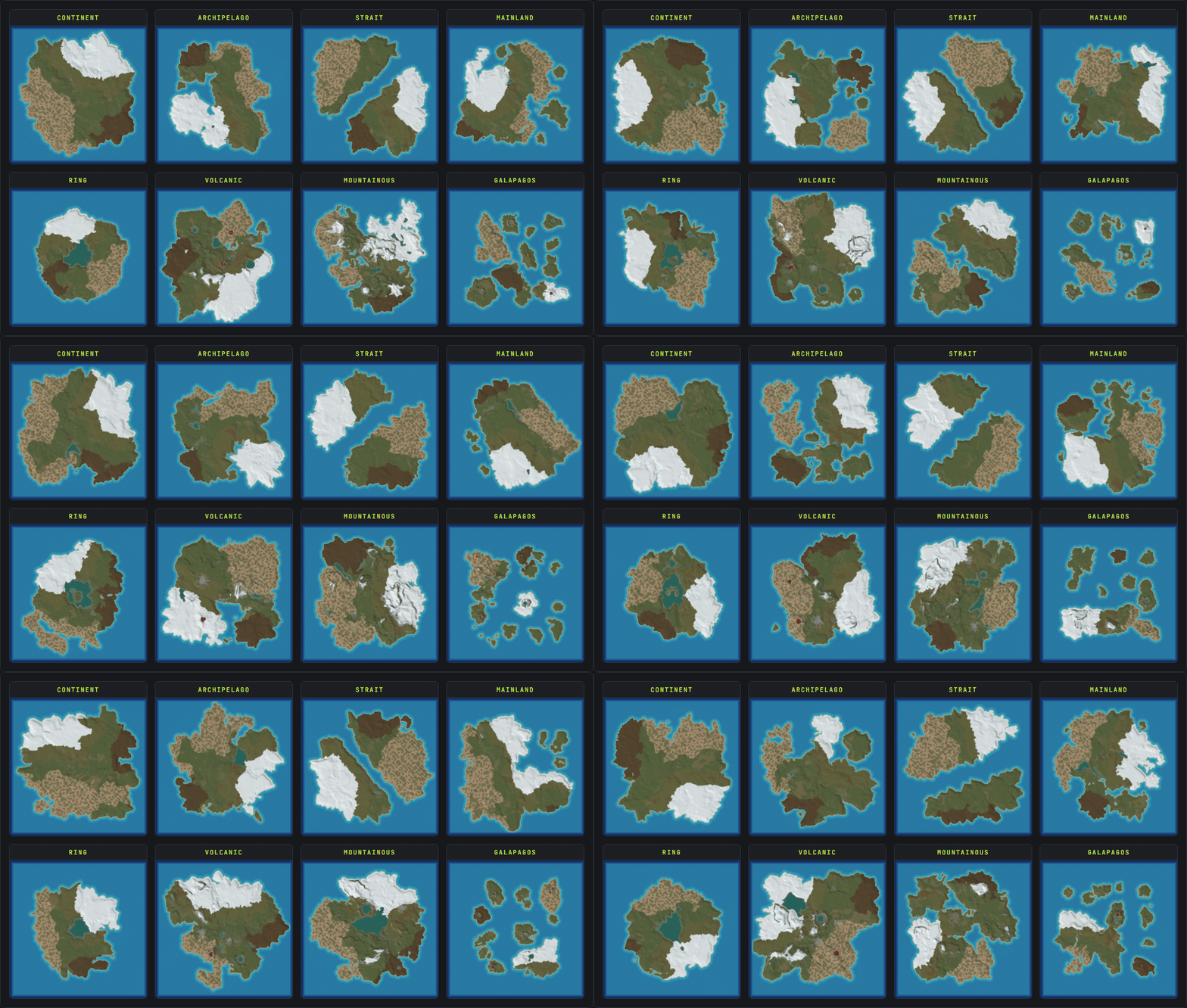
Animated grid of the eight Crucible Heightmap full-map styles, Continent, Archipelago, Strait, Ring, Mainland, Volcanic, Mountainous and Galapagos, each cycling through generated Rust maps
Volcanoes

Volcanoes, craters and calderas. With lava.

Three of the eight island styles build a cone: a volcano with lava in the vent and ash fans down its flanks, a crater as a broad walkable bowl, and a caldera as a blown-out ring holding a lake. The lava is Rust's own prefab, so it burns anything standing in it, and it rides into the .map with everything else.

Read the volcano docs
Live 3D viewer

See it in 3D. Paint it like it's in Rust.

A real-time, in-game 3D view runs right inside the app, with real Rust ground textures, water and sky. Fly the camera around your island, paint the 8 Rust splat textures and sculpt terrain height live, and read the slope and grid overlays to see buildable land and in-game cells before it ever touches RustEdit.

Read the 3D viewer docs
Rust cliffs

Rust cliffs, without losing your map.

Getting cliffs out of RustEdit means running its cliff pass, and that wipes the topology already on your map, your lakes with it. So it has always been RustEdit's cliffs or your own world, never both. Crucible places Rust's actual cliff and rock models itself and writes them into the .map, so nothing has to be regenerated and nothing you made gets thrown away.

Read the cliffs docs
$53.88 $ 44.99

/ Billed Annually

Get it in Crucible

Download the launcher, then subscribe in its Shop

Simple to use, affordable, Rust first custom maps.
  • Biomes, topology, ground textures, forests and lakes
  • Rust's own cliff models, no proc gen needed
  • Volcanoes, craters and calderas with real lava
  • Direct .map, plus 16-bit .raw, .png and .xml export
  • Map sizes 513 / 1025 / 2049 / 4097
  • Live 3D preview, sculpt brushes and hand painting
  • Save and share seed profiles (.hmseed)
  • Work across multiple projects, batch export the lot
  • Automatic in-app updates
Crucible Heightmap

Download Crucible Heightmap

Get the free Crucible launcher, then unlock Heightmap in a few clicks and start conjuring worlds.

Download Crucible

1,271downloads

Tutorials & demos

View channel

Get updates & support on Discord

Build news, bug reports, and direct help with the tool. Drop in, say hi.

FAQ

What is Crucible Heightmap?
Windows desktop app for Rust map makers. Generate 16-bit island terrain, combine seeds and sculpt it by hand, then generate the whole Rust world on top of it: the five biomes, Rust's topology layers, ground textures, forests, lakes as real water bodies, volcanic lava, and Rust's own cliff and rock models on the steep ground.

It all goes out in one ready-to-open Rust .map (or true 16-bit .raw and .png), so RustEdit opens a finished world instead of a bare heightmap.

It's built around Rust procedural generation, so beaches, slopes, and cliffs feel naturally Rust-like in-game. The map size you select determines the output resolution of your export.
Do I still need to run RustEdit's proc gen?
Not for the world itself. Your .map already carries the biomes, topology, ground textures, lakes, lava and Rust's real cliff models, so it opens finished. Proc gen is there for monuments, roads, rail and prefabs.

One thing to watch: in RustEdit's proc gen menu the topology passes reset every custom topology layer on the map, and that takes your cliffs and your lakes with them. Leave those off. Biomes and ground textures have their own checkboxes and are safe to run.

Starting from a plain .raw instead? Then run whatever you like, since a .raw carries height and nothing else.
What is RustEdit?
RustEdit is a community built standalone map editor for Rust developed by k1lly0u. You get full control over terrain, splat, biome, topology, alpha and prefab tools.

With the Crucible Heightmap tool you can quickly import a whole custom world that would otherwise take ages to make by hand. Then with RustEdit's tools and its proc gen you can populate a fully playable map with monuments, roads and rail on top of the world Crucible built.

Making it faster and easier than ever to unleash more creativity in the map building process.

Start to finish: generate terrain and its world in Crucible, export a .map (or .raw), then open it in RustEdit and add your monuments, roads and prefabs on top. Check the tutorials and demos above for video walkthroughs and guides with more detailed info.
Do I also need RustEdit?
Yes. Crucible Heightmap and a map editor like RustEdit work together, each doing a different job. A heightmap is your map's terrain skeleton: a 16-bit grayscale image where brightness is elevation, so it defines every hill, cliff, beach and ocean floor. Sculpting that by hand takes ages. Crucible generates Rust-tuned terrain in minutes, then generates the biomes, topology, ground textures, lakes and cliffs on top of it, and exports the lot as a ready-to-open .map (or a plain .raw heightmap). You open that in RustEdit and use its tools (or proc gen) to drop monuments, roads and prefabs on top.

There are other Rust map tools out there too, like RustMapper, but RustEdit is the one I have hands-on experience with. Crucible plus RustEdit takes you from a blank slate to a unique, fully playable custom map, fast.
Can I sell or share the maps I make?
Yes. Heightmaps and maps you create with Crucible are yours. Use them freely, including commercially: run them on your own servers, share them, or sell them on marketplaces like Codefling or Lone.Design. Your subscription licenses the app itself, not what you make with it.
What heightmap resolution does RustEdit use?
RustEdit accepts 513×513, 1025×1025, 2049×2049, and 4097×4097 pixel heightmaps. Crucible matches these exactly based on your selected map size, exported as true 16-bit grayscale .raw (or baked into the .map export).
How can I play / test my map in Rust?
Spin up a local Rust server, load your map onto it, then connect and walk it in-game. I cover the full local hosting setup in this video tutorial.

🌲 Get 30% OFF your RUST server hosting with Pine Hosting!
Use code DRIZZZA here - https://pine.host/drizzza
How do I load my custom map on my local Rust server?
Save your exported RustEdit .map file somewhere (I like to create a new folder in my server root called maps), then point the levelurl in your server .bat file to the map file path. The code below shows how to properly update your server .bat for this:
@echo off
:loop

cd /d "C:\Path\To\Your\Server\Folder"

echo Starting server...
RustDedicated.exe -batchmode ^
+server.port 28015 ^
+server.levelurl "file:///C:\Path\To\Your\Maps\yourmap_v1.map" ^
+server.maxplayers 1 ^
+server.hostname "Your Server Name" ^
+server.identity "yourserver" ^
+rcon.port 28016 ^
+rcon.password YOUR_RCON_PASSWORD ^
+rcon.web 1

echo Server stopped. Restarting in 10 seconds...
timeout /t 10

goto loop
What to change:
  • cd /d path: the folder your RustDedicated.exe lives in.
  • server.levelurl: the full path to your .map file (keep the file:/// prefix).
  • server.hostname / server.identity: your server name, and a save-folder name for this server.
  • rcon.password: set your own and never share it.
Once it's running, launch Rust, press F1, and type client.connect localhost:28015 to join and walk your map.

Updating a map? Either save each new version under a different name (e.g. yourmap_v2.map) and point server.levelurl at it, or delete the old .map from both places it lives: your server identity folder (...\server\yourserver\) and your Rust client's map cache (C:\Program Files (x86)\Steam\steamapps\common\Rust\maps).
What do I need to run Crucible Heightmap, and does it run on Mac or Linux?
A Windows PC. That's it. Download Crucible, open Crucible Heightmap from the launcher, and subscribe in the launcher's Shop to unlock it.

Mac or Linux? It's a native Windows app, so it won't run on Mac or Linux out of the box. There are likely ways to get it working if you're an avid Mac or Linux user though.
How do I download and update Crucible Heightmap?
Download Crucible from the download page, or the Download link in the footer. Install it, open Crucible Heightmap from the launcher, and subscribe in its Shop to unlock the app.

Updates happen automatically when you open the app, no reinstalls and no chasing downloads. When a new version is ready you'll get an "update available" prompt on launch, and you can check anytime in Settings.
How are payments and licenses handled? Is it secure?
Checkout, billing, and license keys are all handled by Lemon Squeezy, a trusted payment provider and merchant of record. They process the payment, handle sales tax and VAT, manage recurring billing, and issue and validate your license key.

Your payment details go straight to Lemon Squeezy's secure, PCI-compliant checkout, they're never seen or stored by us. As merchant of record, Lemon Squeezy is also the name on your statement and the party responsible for tax compliance, so you're covered by an established platform rather than a one-person operation handling your card.
How do I manage my subscription?
Manage it right in the launcher's Account panel: change plan, update your card, cancel or resume. It also runs through the Lemon Squeezy billing portal: crucibleheightmap.drizzza.com/billing, the Manage subscription link in the footer. Log in with the email you bought with and you'll get a one-time login link.

You stay active through the rest of whatever you already paid for, then the launcher stops opening the app. Anything you made stays on your PC.

Changed your mind? If you resume before your billing cycle ends, it's the same subscription with the same license key, nothing breaks. If the subscription fully expires and you buy again later, that's a new order with a brand-new key, and the old one won't work anymore.
Can I use it on more than one PC?
Up to 2 Windows PCs per license. Switching rigs? Hit "deactivate" in the launcher on the old one first. That frees the slot, then you can activate on the new PC.
I lost my key.
It's in a few places. The launcher's Account panel shows your license key right there. It's also in your purchase receipt email, and on the billing portal at crucibleheightmap.drizzza.com/billing, the Manage subscription link in the footer. Log in with the email you bought with.

Still stuck? Hit me up in Discord.